

Topline
During a recent Trump speech at a Hanukkah reception held at the White House, President Donald Trump disclosed that billionaire donor Miriam Adelson had offered him another $250 million if he were to pursue a third presidential term — a remark that quickly reignited debate around money, power, and constitutional limits in U.S. politics.
The moment unfolded publicly after Adelson referenced the idea of “four more years,” prompting a reaction from the president and parts of the audience, despite the U.S. Constitution clearly prohibiting a third term under the 22nd Amendment.
What Happened During the Trump Speech
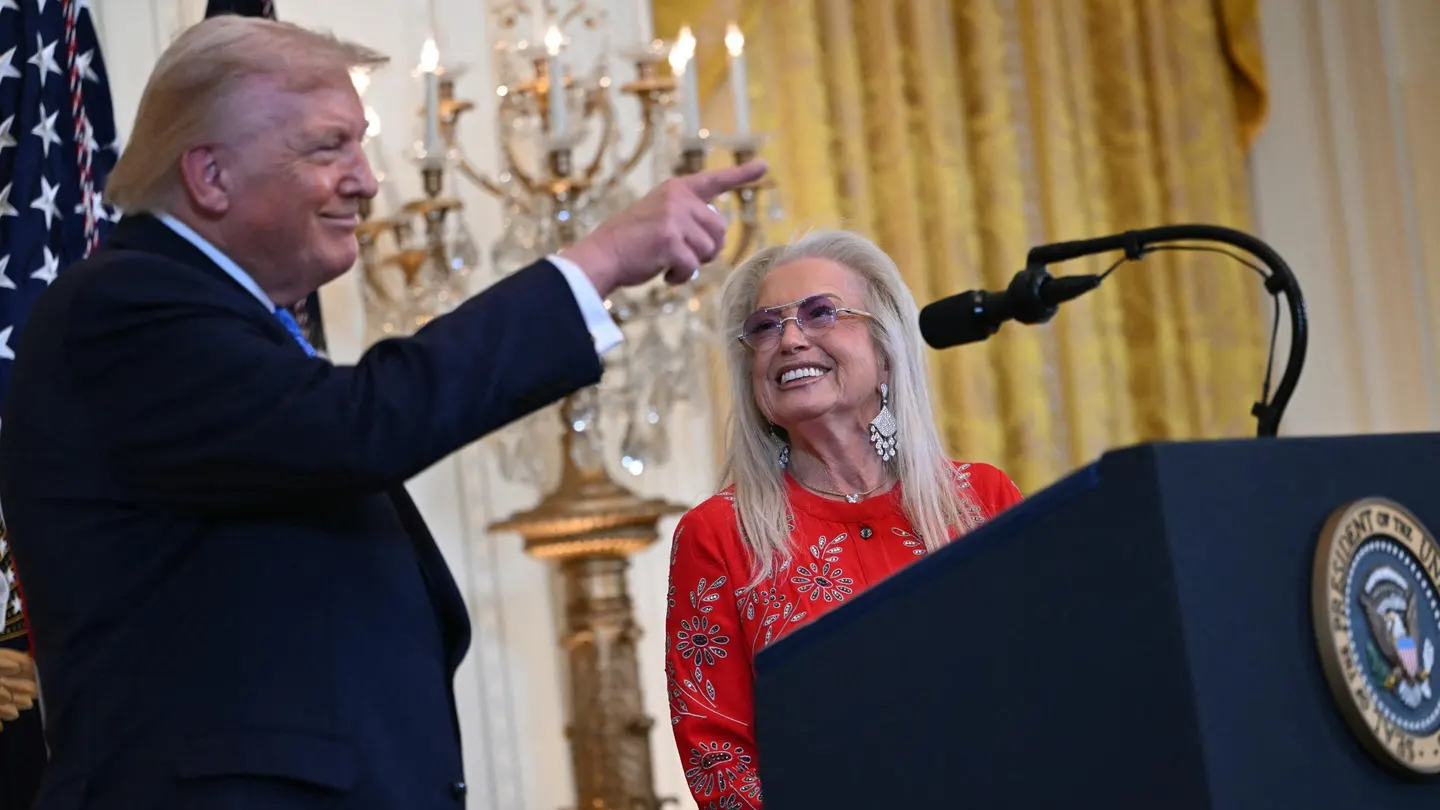
As Trump addressed attendees, Adelson took the stage and referenced a prior discussion with prominent attorney Alan Dershowitz about what she described as “the legal thing about four more years.”
Turning toward the president, she remarked, “So, we can do it — think about it.”
The comment triggered chants of “four more years” from some members of the crowd, as Trump smiled and gestured toward them. Moments later, Adelson leaned in to whisper something to the president.
Trump then addressed the room directly, saying:
“She said, ‘Think about it — I’ll give you another $250 million.’”
The remark was met with laughter, before Adelson publicly responded:
“I will give.”
The exchange became one of the most talked-about moments of the evening, largely due to how openly it tied financial backing to a potential third-term discussion during a public Trump speech.
Trump’s Remarks on Sheldon Adelson and Political Influence
In the same speech, Trump praised Adelson’s late husband, Sheldon Adelson, describing him as one of the most forceful advocates he had encountered during his presidency.
Trump recalled frequent meetings at the White House, noting that what were supposed to be brief discussions often stretched far longer. He credited Sheldon Adelson with being intensely focused on U.S.–Israel relations, stating that his primary concern was “to take care of Israel.”
During the address, Trump also made broader claims about lobbying power in Washington, asserting — without citing evidence — that Israel’s influence had diminished in recent years and alleging that Congress was becoming increasingly antisemitic.
The Bigger Context Behind the Trump Speech
Since returning to office earlier this year, Trump and several close allies have repeatedly floated the idea of a third presidential term, even as constitutional restrictions make such a move legally impossible.
The conversation has extended beyond speeches. Merchandise branded with “Trump 2028” has appeared online, while some Republican leaders have downplayed the remarks, suggesting Trump is deliberately provoking political opponents rather than signaling a serious legal challenge.
Trump himself has previously acknowledged the constitutional barrier, stating publicly that he is not permitted to run again — while also emphasizing that the Republican Party has multiple strong candidates who could lead the ticket in 2028.
Adelson’s Financial Role in Trump’s Political Network
Miriam Adelson remains one of the most influential financial figures in Republican politics. Her estimated net worth stands at approximately $47.0 billion, placing her among the wealthiest individuals globally.
Source: Bloomberg Billionaires Index
During the 2024 election cycle, Adelson donated an estimated $111 million to pro-Trump super PACs, making her the campaign’s second-largest financial supporter.
Her presence — and comments — during the White House event underscored the continued intersection between wealth, political influence, and public messaging, particularly when such dynamics surface during a high-profile Trump speech.
For more in-depth coverage on business, power, and corporate influence, explore all our latest Business insights and analysis.
Why This Matters
Beyond the headline-grabbing dollar figure, the moment highlights a deeper issue: how openly financial power now intersects with political ambition in the United States.
When discussions about constitutional limits, donor influence, and future leadership unfold in public speeches rather than closed rooms, they raise critical questions about transparency, legality, and the evolving role of wealth in modern governance.